Showing posts with label technique. Show all posts

Monday, 25 February 2008

Technique: the overhead position


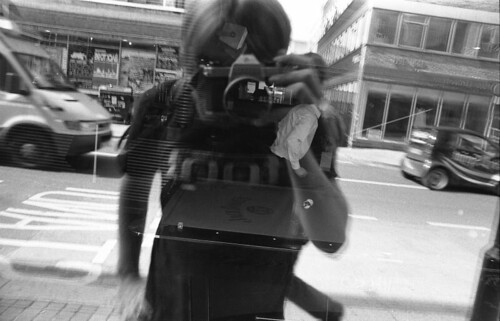
Seriously, if you have never shot a twin lens reflex in the overhead position, you haven't lived. I actually shoot in an inverted overhead posture, so my face is pointing in the direction opposite to the lenses. I do this because I find it faster to just flip the camera over my head and keep the right hand index finger on the shutter. Oh well.

Monday, 28 January 2008

Technique: Olympus XA-1

I wouldn't usually talk about cameras, but with time the very snapshotty and technically limited XA-1 has got to be my camera of choice. It is a normal film camera with a 35mm lens, no way to focus or change aperture. It measures the light with an old selenium cell that usually overexposes during daylight and you can only set it up for 100 or 400 ASA film. But it's terribly small, easy to carry and a no-worrier... as far as you shoot with flash. At night, things that are between about 1.2m and 2.5m will be focused and exposed. Framing is as simple as looking through the viewfinder.


I smashed mine badly yesterday and the flash stopped working and the cover opened. I have to give it to a mate one day to see if he can fix it. In the meantime I'm looking on ebay for an XA2 (more sophisticated... now you are supposed to be able to choose focus) with a larger flash. My idea was to carry two XA's, one in each pocket. One of them has a smaller flash and it's used for most situations when shooting. The other one would have a larger flash and be dedicated for shooting infrared flash and film. Finally all my needed equipment arrived. Back to ebay...


Picture by Maciej Dakowicz.

Friday, 23 November 2007

The so called tilt


This stunning shot by Igor Moukhin has an equally stunning comment by a viewer in flickr. The text, in its original form says:

The horizon is slanted and that is a NO NO for good photography.
By the way, the lady was shot in a very unfavorable pose. I am sure she
did not like it.


Don't know. If that's a reason to bin the picture, I'm a bit shocked. All that surreality in a single stroke, even the dynamism given by the slight slant of what would be an ordinary line in the image. As usually, after reading such a thing I decided to straighten another picture taken by Garry Winogrand. Lets go for it...


Before


After


I don't know about you, but the straight image leaves me a bit cold. Yes, anybody could have shot that. Some woman inside a phone booth. One leg up, a bit sexy maybe.

Lets see the original again...


Isn't there something interesting about it? It's sort of 'cheekily wrong' but at the same time it draws you into completely new parts of the image which follow with different ideas. First, I notice the legs a lot more than I did before. The woman suddenly looks as if she's really locked inside the booth. Her legs are the only close-to-vertical pillar that draws my eyes in the image. She's more separated from her context than in the straight image. If that was a real hill you could think that she's standing on the wall of the phone booth. All the people in the background are walking uphill as well and we have that face on the top left corner. If the shot was straight we would have seen too much of the sidewalk on the right, even more people. And I like all those diagonals of the booth, a bit of which covers the face of the girl. Just lovely. The straight one is just boring in comparison.

The whole thing is that the image itself is self contained. When we walk around we can tilt our head in any direction and still everything looks at level with the horizon. I guess that it's not only due to our vestibular system in action, probably we have learned to normalize our horizon when seeing. Photography allows you to put a frame around an image, for the first time creating a tilt that can not be normalized as it's inside a square. This is a whole new world of visual experiences that can be explored. The hard thing is to create an image that in the reference coordinates of the image is balanced and natural, even if it does not agree with the references of the real world. Somewhere the tilted image (relative to world coordinates) has to be 'anchored' well enough for it to not result disturbing.

- What's with the tilt in your pictures?
- What tilt?

Rock on.

Sunday, 14 October 2007

Shoot like... Bruce Gilden

You walk minding your own business in some street. At day, at night, doesn't matter. Maybe in Tokyo, maybe in New York. If you're unlucky, even in Puerto Principe. Suddenly, a big figure, with head covered with a dark hat, lots of clothing creates a bearlike embrace. A tremendous flash of light follows. You're blinded. He dissapeared. Was this an alien abduction? A kidnap attempt? Well, most probably, it was Bruce Gilden.


If there's somebody that shoots physically close, that's Gilden. And he's not subtle, no way. He shoots with flash even in daylight. He's probably not the invisible photographer, but the stunning factor is on his side. His images of New York make it look like a frenetic and mad city, even if he focuses on the individuals that populate it. Japan is nasty, dark, full of tough yakuza guys with tattoos and cigarettes. His fashion magazine is an ode to mafia capos and beautiful femme fatales. He's cool and blunt. His aesthetics follow that bluntness.


You need

A small 35mm camera and a flashgun. It doesn't matter if the x-sync of your flash is not the fastest ever (no leaf shutter needed!) as a bit of that blurriness of slow shutter speeds add to the feel.

A wide angle lens. Accounts vary, but Gilden seems to shoot with a 28mm or a 24mm lens. Probably with both.

Lots of practice shooting with the camera in one hand and the flash in the other. Come on, it's not easy to focus when you do this! Also, take in account that the power of the flash or the aperture have to be set in accordance to the distance to the subject (to not underexpose or overexpose). Try to do this with one hand. Hard, innit? Well, after all you'll end up pre-exposing almost every shot. So you need to know what to shoot.

Bodyguards. I mean, you can't do this and stay alive for very long. You can call them assistants. It sounds cool, and makes you sound more like a photographer than a local godfather. (There's a cached blog entry about this.)

Lots of balls. In the female version you can find your local equivalent. You shoot close and people see you. You shoot closer if you just can't be close.

A strange eye for composition. You focus in parts of people. An expression, a few hands. The woman with the nice hat and the man with the watch look promising... get close, closer, you have nothing else in the frame, you shoot. That's it. Get rid of the backgrounds and streets, who wants them.

Good dresscode. First of all, silent shoes or trainers. Don't try slippers, they don't give that slightly rough image you have to keep for keeping your subjects away from you after shooting. Dodgy hats and gloves help. A beard. Make it look as if you just stole that Leica in your last 'job'.


Pros

Some stunning images. So close, so big. Wow factor guaranteed.

Fashion editors think that you're so odd that they want you to shoot some beautiful models with nice handbags. Gosh.

You find subject matter everywhere. After all, you only need people. The more variety and the weirder exemplars found, the better.


Cons

You have to compete with Bruce Gilden.

Risk factor: you can end up badly beaten by your local version of mafia or criminals. Even football hooligans are nasty, man! Remember, even if you are invisible, your flash is not.

You depend a lot on good and tight editing. After all, most of the shots are done in a similar fashion and the ones that work really work. Lots of chances to get beaten up before you finish a book.

Short life expectancy. Do I have to repeat this? (Wait till we review Robert Cappa, a war photographer whose motto is "If your photos are not good enough, you're not close enough.)

You can run out of batteries for your flash. Seriously, you need to carry plenty of crap unless you shoot with an XA2 with an A9 flash.

Your pictures are not that popular with all audiences.

Overall

If you have a taste for action, give it a go. After all shooting like Bruce Gilden teaches you lots of technique. And balls. You can also meet some interesting people. Anyhow, if you apreciate having legs, you might still want to stick to shooting like Henri Cartier-Bresson. If you have a thing for shooting people with flash and don't like the risk involved in shooting like Bruce Gilden, you might want to consider shooting like Diane Arbus. Soon we will have her 'shoot like' in this blog.

Thursday, 11 October 2007

Technique: how to hold your Leica (or things that Garry Winogrand didn't know?)

Here is my first go at explaining technique. Where to start from? Oh well, how to hold your Leica, of course! Lets see it in images:


How does it feel? Nice, eh? As can be seen on the picture on the left, this technique is easy. You grip robustly your small 35mm camera with both hands, surrounding it gently. The right hand goes around the right side of the camera, and the left around the left side of the camera. Don't forget to make the lens point forwards! Feels nice, eh? Well, now you have to place your right index finger on top of the shutter (without pressing, that might waste your film, mate!) and place your eye on the viewfinder. Depending on the camera the viewfinder might be located in different places. Look at the back of your camera to figure out where it is. Usually it is a round or rectangular hole and you can see through. In case of using a SLR, search on google, as you might have to take the lens cap off before seeing anything. You might have noticed that we have been talking about the right hand till now. But we have two hands and cameras are complicated. The left hand is usually used for focusing the lens. The lens is that element with glass that protuberates out of the front of your camera. Light gets in and sucked into film by the use of magical chemicals that we will cover some other day.

Do you feel comfortable? Does it feel nice, eh? That Leica is almost under your thumb now. Now, you have to do what Garry Winogrand never managed to do. Hold the camera at level. Yes, nice. Looking through the viewfinder things should look straight. Also your bearlike grasp will make things sharp. You might get all kinds of funny blur and shake if you do otherwise. Lets see an example. In case you hold the camera as in the example on the right, the result might look instead like this:


Flawed. I've taken the liberty of correcting this image. If Winogrand had not been in a hurry to go to buy more doughnuts he would have shot it as in the example on the left handside. Then the image would have looked as seen next. I must say that I took off the man on the right handside for ease of rotation and cropping. It also makes it just flawless:


Picture: World's Fair, New York, 1964, by Garry Winogrand.
First image comes from the instruction manual of the Leica 3F.

Sunday, 7 October 2007

Shoot like... Henri Cartier-Bresson


Cartier Bresson became famous for capturing amazing moments on 35mm film. In the 20's and 30's when he broke through with his first exhibitions, the 35mm camera was not well established as a tool. Delicately handling a small Leica he managed to juice the potential of photography as an art. Being trained as a painter, we can see how different his approach to photography is: while painting allows to produce any possible thing you might imagine given enough time, photography can -on the run- capture the most amazing, beautiful and ambiguous images. And still feel real.

You need

A small handheld camera with a quiet shutter. Having control of focus is a plus, as it allows you to select things and make jokes. Exposure control is not that important, after all, you shoot during the day. Lenses are really cheap as well: you either use a normal lens (50mm in a 35mm film camera) or a slightly wide angle (35mm in a 35mm film camera).

The eye of a painter in terms of composition. Is not only that you shoot quickly something that fills the frame with wonder, you also have to have the right backdrops and geometry for it.

The reflexes of a scorpion. You quickly bring your camera to your eye when you need it and shoot before being noticed. The sense of timing, the ability to freeze a moment on a print is what you're known for.

Somebody really good to produce your prints. After all, you're only worried about hunting the next image. That's all that matters.

Never to crop your images!

Always frame in terms of the horizon. After all, these might be strange fleeting images but they are available in reality.

Always use natural light. Black and white is a must, but we can drop the need for film by now.

Pros

Everybody loves your images. They are just stunning. They define what photography and photojournalism is about for years and years to come.

No matter where you are you can shoot. After all, you don't need to know anybody to see something interesting and snap it away.

It's damn cheap if you discount the travelling and the expenses on film (which are not that many rolls at the end of the day, just a few shots to set the scene and then the definitive, decisive moment shot).

Some rich women must love your ideas about art and politics.

Cons

You drive yourself mad in terms of what direction your photography should take. And you can't stand those magazines that you should be working for. Sometimes you give up photography for painting (and you're just average at it), other times, for the production of left wing documentaries.

Hiding your camera. It is small, but you are shy enough to have to hide it inside something else -yes, a cheap napkin will do-. In days of manflu this might lead to extensive cleaning of your equipment.

Getting bored waiting. Once you have the backdrops in place you have to stay lurking around for sometimes quite a long time. This definitively is not for everybody, and it can be a bit suspicious for people around (much more than walking down a street snapping at everything).


Overall

I must deeply recommend to all newcomers to shoot like Cartier-Bresson. It's unexpensive and can be done everywhere, and the pro's easily overcome the few things you have to worry about. All you need after all is a bit of eye and a camera that works. No trickery involved, so you don't really need to learn that much. Also, apart of producing beautiful images that your friends will love, it will skill your reflexes.